
AI is fascinating, as is the human brain. And now our brains are on AI every day.
My days are full of coding agents and AI-driven work. I am often in these conversation loops with AI, scanning over text to find the key bits of information I need to keep it going on its own for a while longer. Sometimes I see immediately what I need in the AI text, and other times I feel like I am on the hunt for information in a sea of mush. It puts my brain in a mode to scan for information differently than before. The shift to using skimming and scanning reading techniques more started well before generative AI1; I think working with AI pushes us even more in that direction. It takes effort to slow back down and read not for the information but for the benefits to our human brains.
Warning Signs of a Melting Brain
In addition to “forgetting” how to read for the sake of reading, one of my lingering fears is that I will start using AI-isms in conversation with real people: the words and phrasing that show up again and again in AI-generated text. We tend to absorb phrases our closest friends say because we talk with them so often. If you’re working with AI all day, there’s a good chance one of its AI-isms will sneak into your vocabulary. If you use Claude, you may have seen “load-bearing arguments.” I have seen it now in so many documents from different people, and in my own AI-assisted technical documentation. It’s a common Claudeism. Have you caught yourself saying “You’re absolutely right!”, or “It’s not X, it’s Y”?
Each model manifests its flavor of AI writing, and it changes as models change. Claude Opus 5 was notorious for excessive verbiage and term invention, where Opus 5.5 is a relief from that and more concise.2 GPT-6 Astra is pretty crisp3 and GPT models in general have been great for cutting through the chattiness of Claude text; however, they all write with their own AI-isms. I find each model has its strengths; I rotate between the latest ones to get the best out of them. The time I spend engaging with them and analyzing how they function enables me to build an intuition for each one. Which means on some level I have internalized their behavior.
Beyond the AI-isms, there are the AI conversation loops, which differ from human discourse. I’d wake up in the morning and my brain was already in “AI conversation mode” knowing I had to go keep my AI sessions going like I was feeding little digital pets. I’ll touch on that in a future installment of this new series. Given the reading patterns I had adapted to and the AI-isms, I realized that I wanted to balance out AI input with human input and human-created words.
AI Writing Has a Shape; Human Writing Is a Wonderful Chaos
AI writing has a distinct shape as compared to words that come from human thought. Studies comparing older and newer models show that a newer model doesn’t necessarily mean the output will be more human-like. Some deviate even further from human writing in terms of vocabulary and grammatical patterns.45 Additionally, AI follows structures and creates story arcs that fit into a set of patterns.6 If you imagine the variation of all possibilities in writing mapped to a terrain, AI ends up in a narrow cluster and human writing is literally (pun intended) all over the place.7 Which is beautiful in my opinion; variation and diversity make us think and can help us be creative.
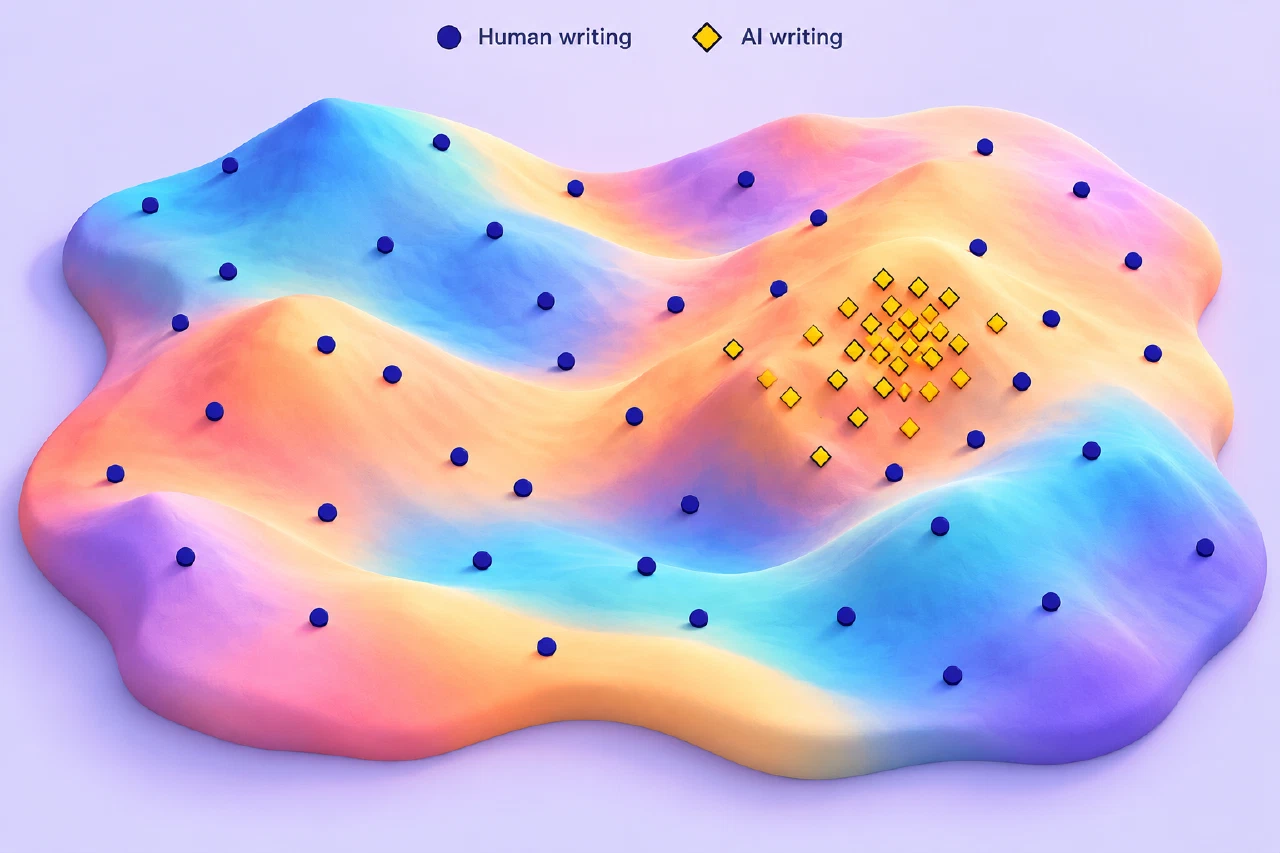
A conceptual illustration of the pattern described in the research; not a plot of the study data.
AI text tends to be more predictable, much like the narrow cluster in the terrain.8 Models are trained to predict the probabilities for the next tokens which are words or parts of words (with some degree of variation of course). Our brains respond more strongly to unexpected information and words9; ideas that are new to us, topics we need to think about to understand.
It’s not just AI-authored content that can be AI-shaped. AI editing and polishing can nudge authors into normalizing towards AI-shaped content.10 In other words, AI may polish away the author’s authentic voice. Ideally editing maintains and hones the author’s voice and intent. When using AI for editing and polish, the outcome depends on the process and what control you maintain over the writing. Side note: I used AI to review this post (more on this later), and I maintain instructions to not change my words. That way I can get an analysis without worrying about it changing my output. That said, it still suggested an “It’s not X, it’s Y” rewrite despite my instructions.
AI-written text is fine for a purpose; for me if I am trying to find specific information for a task or research or learning, that’s a specific mode. It can include interactive learning, which is pretty amazing. For emerging technology, it is often better than just internet research let alone waiting for a book to come out.
Maintaining Structural Integrity in My Brain
I have this visual in my mind that if I let AI melt my brain, I’ll have a hull breach and lose structural integrity, and that will be it. While that is not a likely outcome (it is true I have many brain cells dedicated to Star Trek), it is important to keep a balance of what I absorb.
The line you want to draw for yourself might be different than mine. I’ll share my current approach that helps me do AI-advancing work and maintain a balance so I continue to benefit from and add to human creativity.
When I read, I intentionally make space for getting information through human-produced words. Since we are all busy humans, I know there’s not endless time to fill but there are ways to prioritize what you need to do for yourself. I make time to read human-authored books, read articles that I hope are from humans, and read blogs from my colleagues; there’s so much content to pick from. I want to keep my ability to read diverse text, learn new vocabulary, understand the human emotion behind the words, and do the thinking that different kinds of text require. I make sure I get variety in style, vocabulary, structure, feelings. I need to ensure I am not only getting input from AI.
When I write, I use AI differently depending on the domain, purpose, and audience. AI is great for gathering information, structuring, and summarizing. In my work, technical documents benefit from AI assistance if you give it the right prompts and context and structure. However, for strategy, problem solving, and creative work, I lean towards drafting first based on my thoughts since writing is in essence a thinking exercise.
If ever there was a perfect time to use my brain for writing my own words, it is writing a post consisting of my own thinking. I have experimented quite a bit with AI and in the past have let it guide me towards an arc, or a wording that I thought sounded better than my own. I take these suggestions from AI now with a grain of salt. Because diversity in writing matters, the odd quirks and story arcs might be the very ingredients that keep things interesting for us.6
I write the words; AI reviews. When the point of writing is expressing my thinking, I spend the time to write the words. I use AI to review and iterate but not manage my wording or structure. I’ve got my set of things I use it for, like catching and fixing small typos and grammar mistakes, as well as reflecting back to me what the story arc is. One oddity of my writing is when German sentence structure sneaks in and I get super long sentences and reach for more complicated verb tenses than I need. AI helps me identify where I get wordy and speeds up the process I go through to get less wordy. I also use AI to research and verify supporting references. With this mix of things I’m meeting my goals of practicing using words, contributing to the corpus of human-written content, and applying AI for where it helps me strengthen my work.
Structural Integrity at 97%
I wrote this post based on conversations I’ve had with friends and colleagues over the past few months. When I approach a post like this, I keep in mind that one big thing I get out of the writing is the process of doing it.
If I skip the process and hand over the pen to AI, not only is the result AI-shaped, but I miss out on the benefits of writing. I saw a post online of a teacher explaining to the classroom that using AI to do all the work when you are trying to learn and solve problems is like signing up for the gym and sending your friend to go instead of you going yourself.
I think that applies to all of us when we choose to use AI. Sometimes I choose to leave in oddly structured sentences and prose that AI doesn’t like. And so let me do that here. Just cause I can. 🖖🏻
Liu, Z. (2005). Reading behavior in the digital environment: Changes in reading behavior over the past ten years. Journal of Documentation, 61(6), 700–712. Published article. ↩︎
Anthropic. Prompting Claude Opus 5 and Introducing Claude Opus 5.5 (September 22, 2026), “Communication” section. Anthropic documents Opus 5’s longer default responses and describes improvements in Opus 5.5’s clarity, use of jargon and idiosyncratic phrases, and adherence to writing instructions. Documentation accessed October 24, 2026. ↩︎
OpenAI. Model selection and Using GPT-6, “Personality and writing style” section. OpenAI recommends Astra at low reasoning effort for concise writing, while also noting its tendency toward detailed, formatted responses. These describe settings and model behavior; the comparison with Claude is my experience. Accessed October 24, 2026. ↩︎
Gude, A., Santos-Ríos, R., Bond, F., Flickinger, D., Gómez-Rodríguez, C., & Zamaraeva, O. (2026). More aligned, less diverse? Analyzing the grammar and lexicon of two generations of LLMs. Proceedings of the 64th Annual Meeting of the Association for Computational Linguistics (Volume 1: Long Papers), 38900–38911. Association for Computational Linguistics. Published paper. Free full text (PDF). ↩︎
Kendro, K., Maloney, J., & Jarvis, S. (2026). Do large language models produce texts with “human-like” lexical diversity? Evidence from four ChatGPT models. International Journal of Applied Linguistics, 36(3), 2822–2834. Published article. Free preprint (predates the final published version). ↩︎
Xu, W., Jojic, N., Rao, S., Brockett, C., & Dolan, B. (2025). Echoes in AI: Quantifying lack of plot diversity in LLM outputs. Proceedings of the National Academy of Sciences, 122(35), e2504966122. Published article. Free full text. ↩︎ ↩︎
Muñoz-Ortiz, A., Gómez-Rodríguez, C., & Vilares, D. (2024). Contrasting linguistic patterns in human and LLM-generated news text. Artificial Intelligence Review, 57(10), Article 265. Published article. Free full text. ↩︎
Basani, A. R., & Chen, P.-Y. (2026). Diversity boosts AI-generated text detection. Transactions on Machine Learning Research. Published paper. Free manuscript (updated February 25, 2026). See section 2 for next-token probabilities and sampling, and section 3.1 for the hypothesis about variation in unpredictability. ↩︎
Frank, S. L., Otten, L. J., Galli, G., & Vigliocco, G. (2015). The ERP response to the amount of information conveyed by words in sentences. Brain and Language, 140, 1–11. Published article. Free full text (university-hosted PDF). See section 4.1, “The N400 effect of word surprisal.” ↩︎
Sourati, Z., Karimi-Malekabadi, F., Ozcan, M., McDaniel, C., Ziabari, A., Trager, J., Tak, A. N., Chen, M., Morstatter, F., & Dehghani, M. (2026). The shrinking landscape of linguistic diversity in the age of large language models. Nature Human Behaviour, 10(10), 1925–1942. Published article. Free author manuscript (updated August 24, 2026). ↩︎