Why vision matters now.
Recently someone said to me, “Now is not the time for vision.”
This statement gets the relationship between uncertainty and vision backwards. If we are uncertain about the path forward, vision helps us clarify where we want to go. With that direction, we can begin figuring out the concrete steps to get there.
At Amazon we have a Leadership Principle for how we adapt: Learn & Be Curious.
“Leaders are never done learning and always seek to improve themselves. They are curious about new possibilities and act to explore them.”
It describes this crucial ability to adapt and maintain the skills and knowledge to do your job. It is also the essence of vision. Now, more than ever, Learn & Be Curious is what will keep all of us moving with industry change brought about by advancements in AI.
Why we choose to move forward.
Learn & Be Curious is not only about keeping our skills current; it’s how we see possibilities we didn’t see before. As someone who has built in this industry through many evolutions in technology, I will put a stake in the ground: it is always the time for vision. Technology is rooted in innovation and vision and making that real.
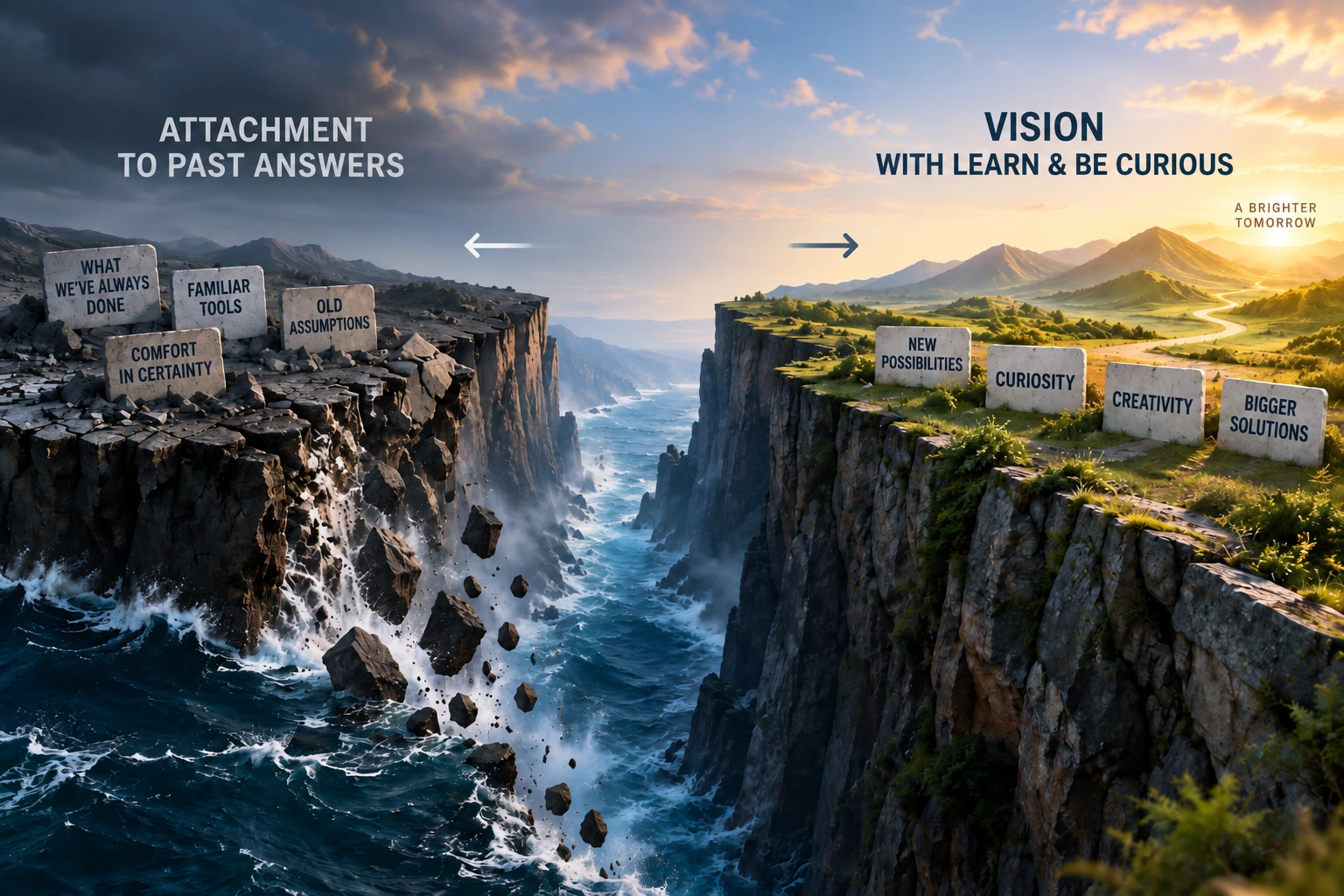
I have this image in my mind of a rift opening between two tectonic plates. One side is vision carried by Learn & Be Curious. On the other side is attachment to past answers. The plates are moving apart faster and faster every day, and you have to choose where you stand. The side holding past answers is sinking as it moves away; it might feel safe if you don’t notice the slow sinking underneath you.
The learning plate is carrying us fast into unknown territory. There is opportunity in the uncertainty and the unknown - to imagine what we can make possible, and what new solutions to problems we can discover. This is where we explore new ideas, where science and technology advance. If we arm ourselves with a learning mindset, we can most definitely adapt to what’s changing.
What we choose to bring with us.
Choosing the learning plate doesn’t mean leaving everything behind. The sinking side holds only old answers; what we carry across is the understanding that led to them and the judgment to decide if the answers still apply.
All the tools that you have for your job are just tools. If you think about why each tool exists, what goal it serves, and how you decide when to use it - you see patterns. You see it’s not about the tool, it’s about why it is there and how you apply it. Those are skills you have that help you adapt. Lean on those. That’s the strategic thinking that keeps you from getting stuck in the tactical. In terms of the plates: tactics are the answers, and they stay behind when circumstances change. Strategy, the understanding of why, is what you carry across and use to build new ones.
To be even more Amazon, let me quote a Principal Engineering Tenet. We principal engineers have a set of tenets we operate by and this one helps ground us in our innovation: Respect what came before.
“Principal engineers are grateful to our predecessors. We appreciate the value of working systems and the lessons they embody. We understand that many problems are not essentially new.”
Understand the past, the patterns, and the why. Respecting what came before does not mean preserving every answer; it means understanding the problems and constraints and options that led to those answers. It means recognizing when circumstances give us the opportunity to do something different - and do something better.
Our experience helps us see and understand what is important, our curiosity helps us discover what is possible, and our vision gives us something to build toward. Together, they help us turn what we imagine into real solutions we can build and deliver.